
Pope County Projected Release Meaning
Illinois IDOC uses the label Projected Discharge Date. It is a current estimate for the end of the legal sentence or supervision framework, not a promised pickup time. The actual institutional transition may appear as a Parole Date, and a jail release requires its own physical exit record. Those records answer separate questions.
A pretrial detainee has no calculated prison discharge date. The Pope court may order pretrial release, detention, dismissal, probation, time served, or commitment to IDOC. Another hold can still delay departure. A court date or disposition date can precede the jail’s processing time.
- Projected Discharge Date
- IDOC’s changeable estimate for legal discharge.
- Parole Date
- The recorded move from an IDOC institution to supervision.
- Final discharge
- The later end of legal custody or supervision.
- Jail release timestamp
- The receiving jail’s record of physical exit or transfer.
Find Pope County Projected Dates
Start by deciding whether the person is in local, state, federal, or immigration custody. Pope County operates no jail. A 2021 inspection documented Saline County holding Pope detainees, but the current receiving facility must be confirmed with Pope Sheriff.
- Call Pope Sheriff at 618-683-4321 and ask which agency received the person after the arrest.
- For a local case, search Pope County Judici and obtain the sentencing, detention, pretrial-release, or mittimus order from the Circuit Clerk.
- If the person was committed to IDOC, open the official IDOC Individual in Custody Search.
- Search by IDOC number when known. Otherwise use last name or birthdate, then match the sentence county and case identifiers.
- Read the full Admission/Release/Discharge area and every sentence block. Preserve each field’s exact label.
- For a local jail sentence, ask the receiving jail for its calculation and physical release record. IDOC may have no profile.
A Saline release can mean community release, another jail, IDOC, USMS, or ICE custody. If the person left Saline on a mittimus to IDOC, that was a transfer rather than release home. Follow the agency that took custody.
Pope County IDOC Date Fields
The IDOC detail must be read as a group. Confirm the IDOC number and birthdate, then compare the sentence county and mittimus or case data with the Pope court file. Parent Institution and Location answer placement questions, while the admission and sentence areas answer different parts of the timeline.
| IDOC label | What it establishes |
|---|---|
| Admission Date | Entry into IDOC, not the original Pope arrest. |
| Parole Date | Recorded institutional exit to supervision. |
| Location: PAROLE | A supervision placement rather than a prison placement. |
| Projected Discharge Date | An estimate that may change or read TO BE DETERMINED. |
| SENTENCE DISCHARGED? | The status of one displayed sentence block. |
One sentence marked YES does not prove all legal custody ended. Another sentence may remain open, or parole/MSR may continue. A projected discharge later than a Parole Date is not a conflict. The first marks a past prison-to-supervision transition, while the second estimates a later end point.
Note: A county-jail-only Pope case may never appear in IDOC because no state commitment occurred.
Pope County Sentence Credit Rules
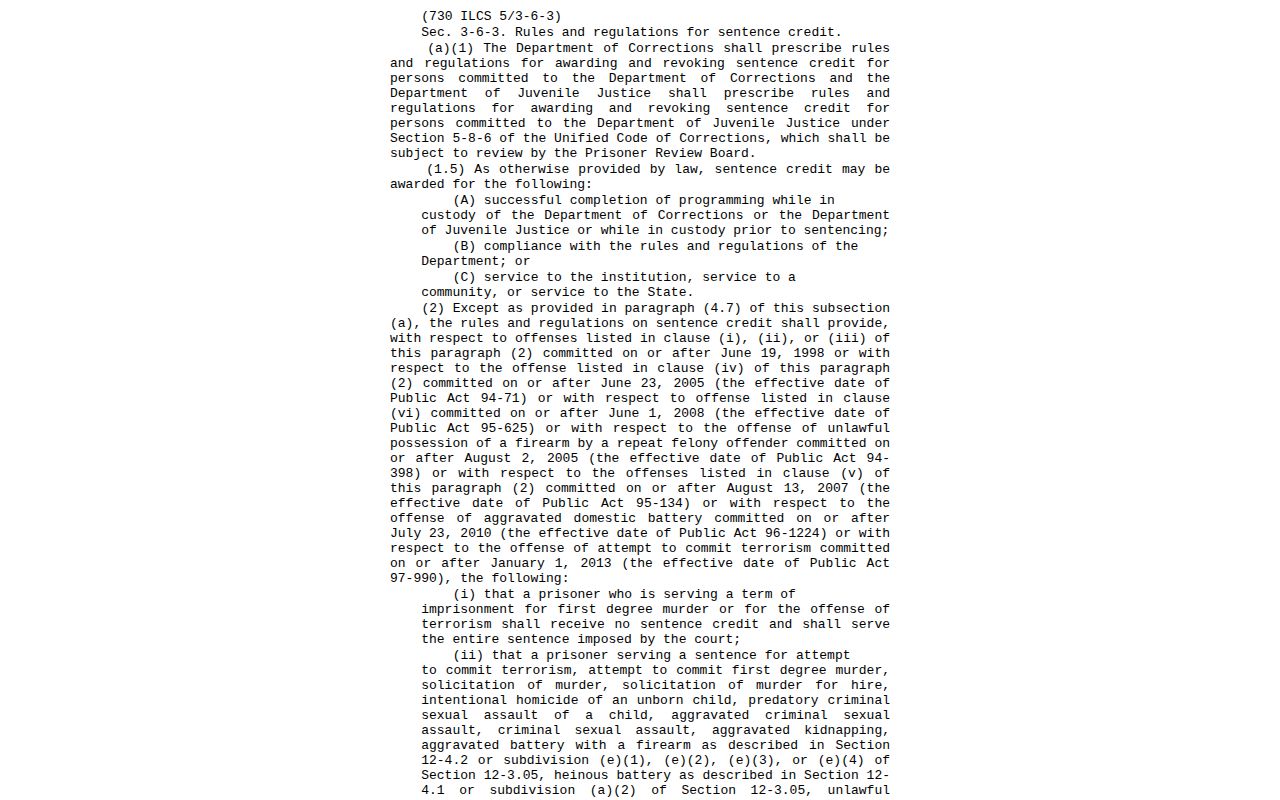
Illinois sentence credit is controlled by the offense, offense date, sentence, enhancements, court orders, and the applicable part of 730 ILCS 5/3-6-3. There is no safe single percentage for every person.
Some listed offenses permit no more than 4.5 days of credit per month, a structure often summarized as requiring service of about 85 percent. Other provisions use different limits, including 100 percent and 75 percent structures. Other eligible sentences can receive one day of sentence credit for one day served, often called day-for-day credit. Those phrases are shorthand, not individual calculations.
Presentence custody credit also matters. The Pope sentencing order or mittimus and the IDOC calculation should account for qualifying local custody time. Simply multiplying the imposed term by a percentage and adding it to the sentence date can ignore presentence days, consecutive terms, earned credits, revocations, and the gap between institutional release and final discharge.
The Illinois General Assembly publishes the official sentence-credit statute used to understand the governing calculation rules.
Why Pope County Release Dates Change
An IDOC projection reflects the information and legal rules available when the profile is updated. Later agency, court, or supervision events can change the displayed estimate or the practical date of transition.
| Factor | Possible effect |
|---|---|
| Sentence credit | Eligible earned credit can affect the agency calculation. |
| Discipline or credit loss | A change in available credit can move an estimate. |
| Presentence credit | Qualifying local custody days must be reflected correctly. |
| Concurrent or consecutive terms | Multiple sentences change the aggregate calculation. |
| Detainer or hold | Another agency may take custody instead of community release. |
| PRB conditions or revocation | Release planning or return to custody can alter the timeline. |
| Court order or data correction | An amended legal record can require recalculation. |
An approved release plan and final processing may also affect the practical transition. The projection is not an appointment time. When a date appears wrong, a court judgment issue starts with the clerk or court. An IDOC transcription or calculation issue belongs with IDOC and should be supported by the governing order.
Pope County Release Date Quirks
Illinois’s live IDOC layout gives the most important state-specific answer to the projected-release question: Parole Date and Projected Discharge Date describe different stages. A sentence block can also be discharged while overall supervision stays active.
Read every sentence block before drawing a conclusion. A person may have several counts, cases, or counties. Terms may run at the same time or one after another. Selecting the earliest or most favorable field can produce a false answer. If the public fields conflict, obtain a written IDOC response.
For a local Pope sentence, the receiving jail and sentencing court control. IDOC may have no record at all. Ask for the exact jail entry showing when the person was discharged or transferred, plus the authority and destination agency. That record answers physical release, while the court order explains the legal basis.
Confirm Pope County Actual Release
A projection should be checked again near the expected transition. IDOC cautions that its information can change quickly. For formal verification, contact the IDOC Public Information Office at 1301 Concordia Court, P.O. Box 19277, Springfield, IL 62794-9277, call 217-558-2200 for routing, or use IDOC FOIA.
- Save the field label, date shown, and date accessed.
- Compare the profile with the Pope court sentence and case identifier.
- Check for a Parole Date and Location: PAROLE after an expected state release.
- Review all sentence discharge flags and any relevant PRB result.
- Confirm a local exit with the actual jail and ask whether it was release or transfer.
Illinois VINE can send a pending release or transfer alert, but the source record remains the proof. The Pope County VINELink check explains how to register and how to confirm the exact event category. A court hearing alert, facility transfer, or roster disappearance is not enough.
For an older Pope County event, begin with the court file and a focused record request rather than expecting an online estimate to remain visible. Give the custodian a narrow date range, full name, birthdate, case number, and likely receiving facility. Ask for existing entries instead of asking the agency to calculate a new date or write a narrative.
A useful request names the admission or booking record, release or transfer timestamp, authority, destination agency, and available sentence calculation fields. If Saline held the person, a signed property receipt can support the release-processing timeline, though it cannot prove the person returned to the community. Another agency may have taken custody after the property process.
When records conflict, compare provenance. The Pope judgment is a judicial record. A jail log is a custodian record. An IDOC profile is an administrative publication. A PRB decision records a specialized board action. VINE transmits an event. Preserve each version and ask each office about its own field rather than selecting one date without explanation.
A released person can also remain under parole or MSR until final discharge. The IDOC Projected Discharge Date may therefore extend well beyond the Parole Date. Conversely, a state sentence block marked discharged may coexist with another active block. The safest answer to “when will they be released” names the exact event being estimated: jail exit, prison-to-parole transition, or final legal discharge.